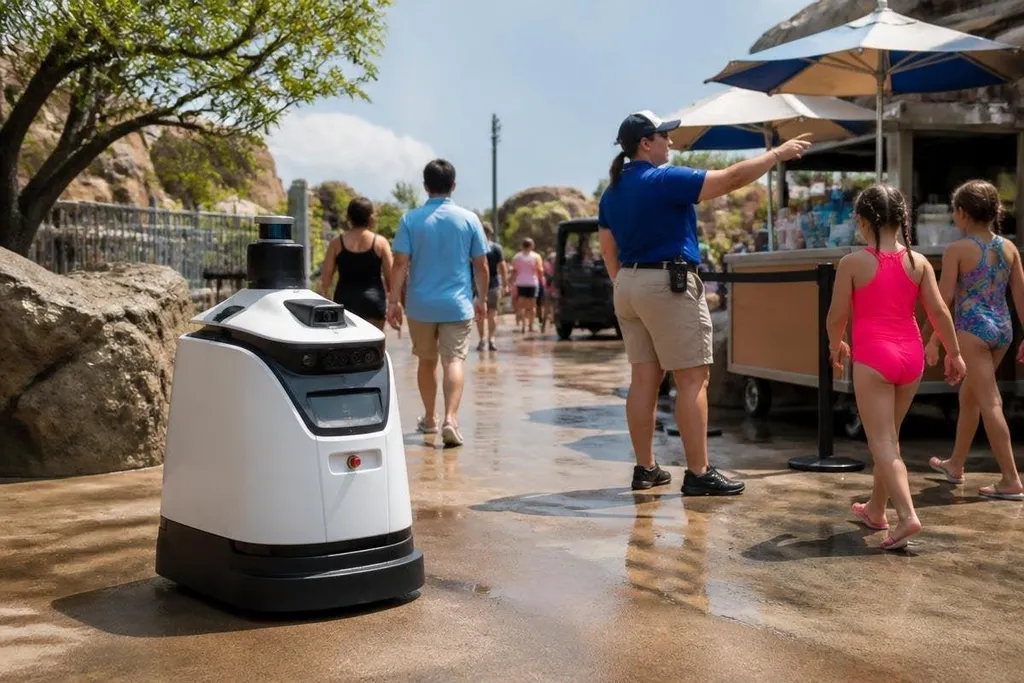
A theme park robot works beside children, staff, barriers, food, water, and moving vehicles. That setting gives robots useful jobs, but it also leaves little room for a sensor fault or a confused visitor.
- Repeated shows and patrols suit robots well.
- Public contact raises safety, privacy, and repair demands.
- A robot that works in a lab may fail in rain, crowds, or bright sun.
Where robots can help
Theme parks already depend on repeated work. A robot can run the same short performance many times, move through a set on a fixed route, or carry out checks in areas that are hard for staff to inspect.
Consistent motion can help a show keep its timing when the park runs several performances in one day.
Robots can also support maintenance. A mobile platform fitted with cameras can inspect fences, signs, pipes, or ride areas during closed hours. With LiDAR, which measures distance with laser pulses, the robot can build a map of its route and detect changes such as a fallen object or an open gate.
The useful job is usually narrow. A robot that repeats one trained routine has fewer choices to make than a general-purpose machine, so the park can test its movement, stopping points, and failure response in detail.
The public changes the safety problem
A factory robot works inside a controlled area. A theme park robot may meet a child who steps into its path, a visitor who reaches toward its arm, or a staff member wearing a costume that changes their shape on camera. The robot needs a clear separation plan for each case.
That plan should include physical barriers, speed limits, safe stopping distances, and an emergency stop that staff can reach quickly. A park should also record what happens after a stop: does the robot hold its position, lower an arm, shut down its motors, or need a technician to reset it?
Standards can guide the work, but a certificate alone doesn't explain how a machine behaves beside a queue. A team assessing a public-facing robot should check relevant machinery and personal-care robot standards, then test the exact robot, route, show, and crowd pattern.
Weather, crowds, and repairs
Outdoor parks add problems that indoor demos may avoid. Water can affect cameras, connectors, and drive systems. Sunlight can reduce the quality of camera images, while reflective surfaces can confuse distance sensors. Dust and food waste can also reach wheels, joints, or cooling paths.
Crowds create a second problem: the robot's route changes from hour to hour. A fixed map may work during an empty morning and fail when visitors stand across the path. Staff need a clear manual mode, a safe place to move people, and spare parts for the parts most likely to wear.
Battery work matters too. A robot that needs a long charge between shows may require a spare battery, a second unit, or a shorter schedule. Ask for the full operating plan, including charge time, inspection time, software updates, and the steps for a failed start.
Privacy and the visitor experience
Cameras and microphones can help a robot detect people, but they can also collect personal data. The park should state what the sensors record, how long it keeps that data, and who can view it. Audio recording deserves special care because visitors may not expect a machine to store nearby speech.
A robot’s movement can shape visitor behavior before it says a word. Slow motion, visible lights, and staff nearby give people clues about where it will go, while a quiet robot that turns without warning can make visitors step into its path. Dated theme park robotics reporting can connect those design choices to the setting and staff response, which also matters when the robot stops or changes course.
A robot also needs a failure message that people can understand. “System fault” tells a visitor little. A sign or staff script should explain whether the route is closed, whether people should step back, and who is handling the problem.
A practical check before deployment
Use this list before a park puts a robot near visitors:
- Define one job: Write down the route, task, hours, and conditions the robot must handle.
- Map human contact: Mark where visitors, staff, costumes, strollers, and service vehicles can enter the route.
- Test the stop plan: Check emergency stops, remote control, restart rules, and staff response time.
- Check the weather rating: Match the robot's IP rating and sensor limits to rain, dust, heat, and direct sun.
- Set data rules: List every camera and microphone, the data collected, storage time, and access rights.
- Price the backup: Include spare parts, batteries, trained staff, inspections, and a way to end the trial safely.
I'd skip any public-facing robot whose maker can't explain its stop behavior, service plan, and data handling in plain language. The next useful proof is a full operating trial during a busy park day, with the robot's failures recorded rather than edited out.